
The Artist Returns
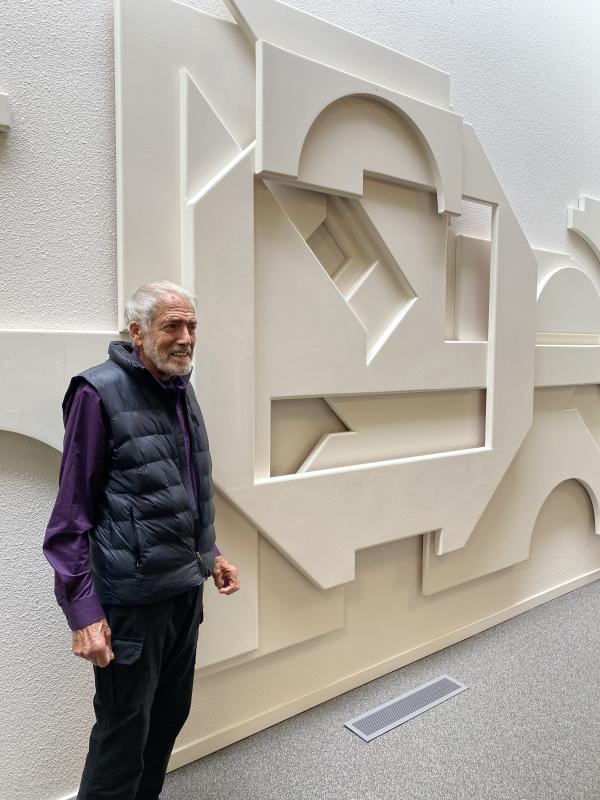
More than four decades after creating two installations for Evergreen Chapel, artist Lutz Haufschild returns to rediscover his early work.
It's been over 40 years since artist Lutz Haufschild last visited the chapel on Baptist Housing's Evergreen campus in White Rock.
Since then, his career has taken him around the world, creating significant works of art in churches, public buildings, and other spaces.
Recently, while researching the history of Evergreen's chapel, one of our team members discovered that Lutz was living locally and reached out to him. Lutz welcomed the opportunity to return and see the two installations he had created early in his career.
Standing in the chapel again, he was seeing his work for the first time in more than four decades.
Lutz took his time, studying the shapes, colours, and details. He remembered decisions he had made all those years ago, while seeing the work through the eyes of the experienced artist he is today.
And what he discovered surprised him.
Lutz had been commissioned to create two installations for Evergreen Chapel: a large, three-dimensional wall relief and a colourful stained-glass window. Both were inspired by the New Jerusalem, the heavenly city described in the biblical book of Revelation.
Rather than creating traditional religious images, Lutz took a more abstract approach.
The white wall relief, with its overlapping geometric shapes, arches, and varying depths, represents a city viewed from above. Lutz imagined what the city might look like from God's perspective, looking down upon its buildings, walls, and open spaces.
The stained-glass installation offers another perspective. Its vibrant colours, architectural shapes, and layers of glass invite the viewer to look toward the city, passing through gates and into the distance.
Together, the two pieces offer different views of the same heavenly city.
For Lutz, the intention was never to explain every detail. He wanted people to bring their own imagination and interpretation to the artwork.
"You have to leave it a little bit mysterious," he explained.
It was a bold approach for a chapel at the time. Some even questioned the unconventional design, but the artwork remained.
Over the following decades, Lutz became internationally recognized for his work in glass and architectural art.
His commissions include 86 stained-glass windows at Westminster Abbey in Mission, The Great Wave at Vancouver International Airport, installations at Toronto's Rogers Centre and Bata Shoe Museum, and large-scale glass sculptures in Taiwan.
Throughout his career, Lutz has occasionally returned to completed projects, comparing his original vision with the finished work. He even developed a habit of giving himself a percentage score based on how closely the results matched what he had imagined.
He’s rarely given himself a perfect score.
As Lutz examined the Evergreen installations, he considered what he might do differently today. There were small details he questioned, but surprisingly little he wanted to change.
In fact, he suggested he might give the project close to 100 percent, considering how well it has held up after so many years.
But he also acknowledged that an artist's perspective can change. Different lighting, another day, or simply seeing the work from another angle might lead him to notice something new.
The visit has even prompted him to consider including the Evergreen installations in a book he is currently writing about his career.
For an artist who has spent decades creating work around the world, returning to Evergreen offered an opportunity to appreciate something he created at the beginning.
And after more than 40 years, Lutz was pleased to see that his artwork remained part of the chapel.
"I'm really delighted that it's still being used and it's still kept as it is."